
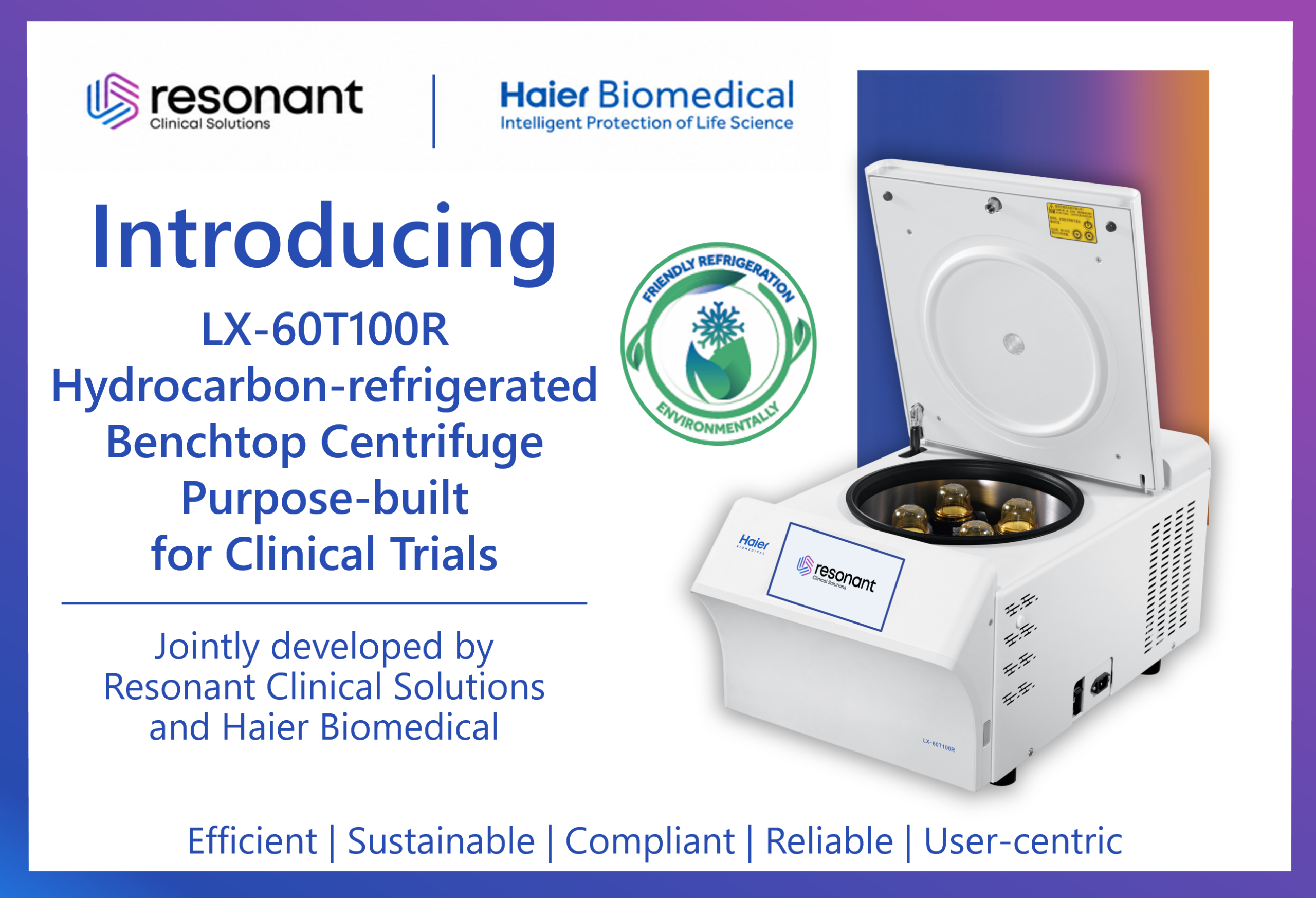
Refrigerated centrifugation is a critical control point in the clinical trial lifecycle — equipment misuse or mishandled samples can compromise clinical data or increase safety risks for the people running it. Yet many traditional centrifuges remain less intuitive, challenging to configure, and slow to pre-cool. Historically, refrigerated centrifuges have also relied on environmentally harmful fluorinated greenhouse gas (F-gas) refrigerants with significant global warming potential (GWP) — prompting EU and U.S. regulators to restrict the use of self-contained refrigeration equipment containing F-gases by 2028.
Haier Biomedical and Resonant Clinical Solutions expanded their existing partnership to address these challenges head-on, pairing device engineering with clinical trial expertise to create a modern centrifuge purpose-built for clinical trials — sustainable, compliant, precise, reliable, safe, and user-centric.
A Modern Centrifuge, Engineered Years Ahead of Regulation
The LX-60T100R Hydrocarbon-refrigerated Centrifuge has launched more than two years ahead of critical industry deadlines. Its architecture was re-engineered around a hydrocarbon refrigerant that cuts GWP to less than 3 — more than 99.9% lower than the previous model — while reinforcing refrigerant lines and ventilation to safely contain flammable material even under worst-case rotor failure.
The operator experience has been vastly improved alongside it, with features including a glove-responsive, 7-inch touchscreen; password-protected individual logins with per-user data management; and automatic energy-saving between runs. Together, these bring enhanced audit-trail accountability and energy efficiency to clinical workflows. RFID-tracked rotors and a biocontainment lid improve risk management and lifecycle tracking for a global footprint, while usage data streamlines regulatory audits for every customer.
The result is an industry-leading, purpose-built instrument that sets a new standard for refrigerated centrifugation in clinical trials.
Designed for the Realities of Clinical Trial Sites
Haier Biomedical and Resonant co-designed the LX-60T100R with the realities of the clinical trial landscape in mind — where repeated equipment use can take its toll at trial sites, which are often in remote locations globally. Clinical trial sites also differ from central labs in who operates the equipment: instruments are typically run by nurses and site staff rather than dedicated lab technicians, so usability was a key consideration from the start.
The easy-to-use interface means staff can operate the centrifuge accurately with minimal training, while every user action can be automatically logged for audit purposes. Resonant also provides a pre-configuration service, setting up the centrifuge to meet each site’s specific process requirements before deployment — reducing both the burden on the clinical trial site and the chance of inaccurate programming.
Safety was a critical focus for the team, given that this high-energy instrument processes patient blood samples. RFID chips on each rotor automatically record completed cycles, warning users as a rotor approaches its recommended end of service life and supporting timely inspection or replacement without relying on handwritten logs. The rotor is also equipped with a bespoke biocontainment lid, providing essential protection for staff from samples should a tube break during the centrifugation process.
This automated recordkeeping also reduces the time and cost of compiling servicing and audit documentation — while rental customers see monthly costs 17% lower than comparable alternatives due to efficiency gains, delivering a measurable financial return alongside compliance and safety benefits.
Every unit is serviced and offers pre-shipment calibration to manufacturer-certified standards, with trained engineers providing personalized support to ensure consistent performance across every site.
The Numbers Behind the Innovation
The jointly developed LX-60T100R addresses clinical trial centrifugation challenges with industry-leading innovation delivering tangible outcomes, with nominal customer cost impact.
- Refrigerant impact: Previous models used approximately 350 g of R-134a (GWP 1,430). The new instrument uses only 65 g of R-290 (GWP ~3) — cutting potential refrigerant climate impact from approximately 500.5 kg of CO₂ equivalent to just 0.195 kg, a reduction of more than 99.9%, alongside an 80%+ reduction in refrigerant quantity.
- Noise: As low as 52 dB(A), keeping the instrument suitable for use in clinical settings adjacent to patients.
- Energy: ECO fastBlast pre-cool technology brings the centrifuge and rotor from room temperature to 4°C in five minutes, using 43% less energy per cycle than standard models. Running three pre-cooling cycles instead of continuous refrigeration over an eight-hour day can cut energy use by up to 88%.
These combined results demonstrate more than incremental progress in equipment design. The LX-60T100R delivers quantifiable improvements in efficiency, operating costs, and environmental impact — and based on current market research, no other refrigerated benchtop centrifuge brings these benefits together in a single system, positioning this innovation years ahead of the regulatory requirements the wider industry will ultimately need to meet.
Existing customers, clinical trial sponsors, and CROs can contact Resonant Clinical Solutions to learn more about the LX-60T100R. Product information can be found here.